
How to get rid of a double chin with aesthetic devices and choose the right technology as a cosmetologist
CONTENTS:
- What causes a double chin
- Which device-based treatments are used
- How to choose a technology based on the underlying cause
- What aestheticians should assess before treatment
- How to choose a device for a salon or clinic
- Treatment limitations and safety considerations
- Frequently asked questions
A double chin is not always associated with excess body weight. The contour of the lower third of the face is influenced by fat distribution, skin elasticity, tissue ptosis, the condition of the platysma muscle, and mandibular anatomy. As a result, a similar appearance in different clients may have different anatomical causes. For an aesthetic professional, the priority is not simply to find a "double chin removal machine," but to identify which tissue contributes to the fullness or poorly defined contour and determine the specific treatment objective.

What causes a double chin
Submental fat is distributed across different anatomical layers. In a cadaveric study involving 20 specimens, fat was identified both superficial and deep to the platysma muscle. In 3 of the 20 cases, the deep fat compartment accounted for more than half of the total fat mass in this area. A visual examination can reveal the severity of the concern, but it does not provide a complete picture of tissue distribution.
Another contributing factor is skin laxity and tissue ptosis. With age, changes in skin properties, soft tissue positioning, and the platysma muscle can reduce jawline definition and contribute to the formation of jowls. Chin, jaw, and neck proportions also influence the facial profile, meaning that noticeable submental fullness can occur even in individuals who are not overweight.
In many clients, localized fullness occurs alongside skin laxity and ptosis. In these mixed presentations, addressing only one component may produce limited improvement in facial contour.

Which device-based treatments are used
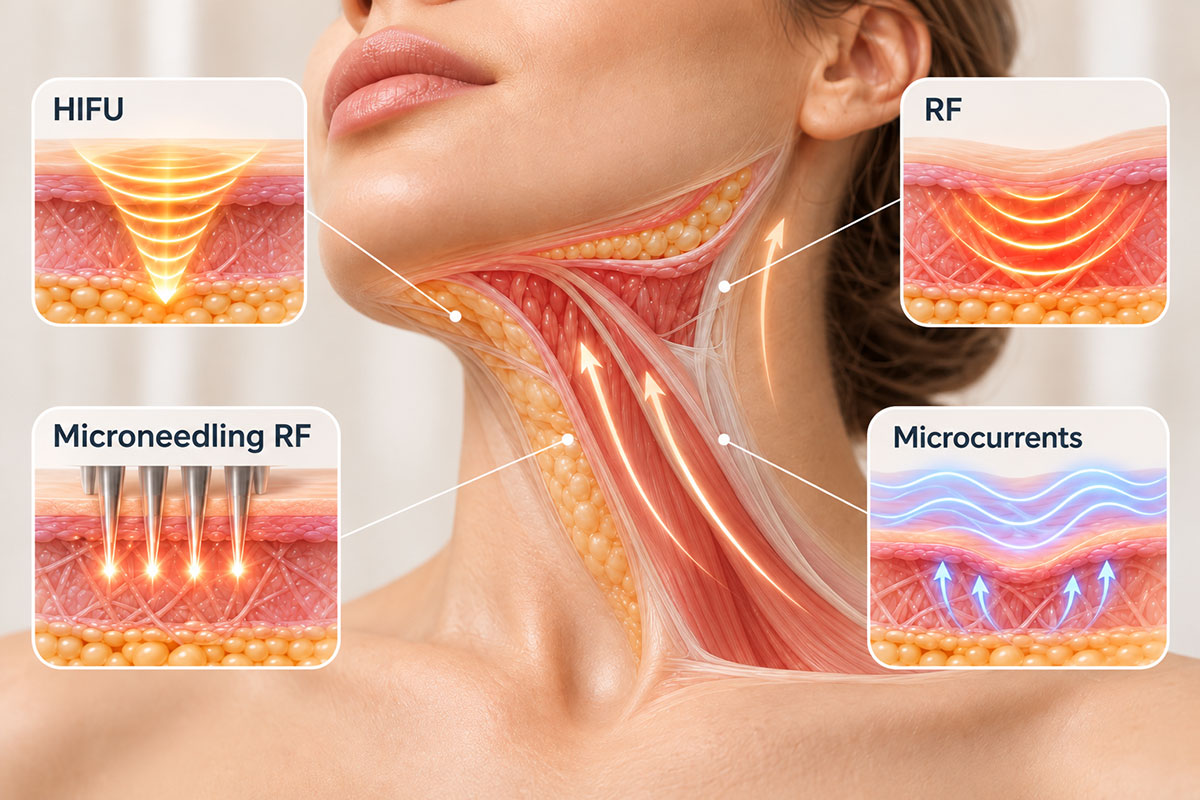
HIFU for targeted treatment at specific depths
HIFU (high-intensity focused ultrasound) creates localized points of thermal energy at predetermined tissue depths. The technology is used for tissue tightening and improving the contour of the lower third of the face. A 2025 systematic review included 45 clinical and cohort studies on HIFU published between 2010 and 2024.
For aesthetic professionals, an important consideration is the ability to select the appropriate treatment depth based on the anatomical area and treatment protocol. The HIFU Super-Lift by Alvi Prague features 1.5, 3, and 4.5 mm transducers for facial treatments, as well as 8 and 13 mm transducers for body areas. The presence of a double chin alone does not establish an indication for HIFU. Before treatment, practitioners should assess tissue ptosis, tissue thickness, anatomy, and the intended treatment outcome.
RF for skin laxity and remodeling
RF (radiofrequency) technology delivers controlled heating to tissues and is associated with collagen remodeling. This approach may be considered when skin laxity and reduced elasticity contribute to poor definition of the lower third of the face.
A systematic review of 21 studies involving 354 participants identified substantial differences among RF systems and treatment protocols. Temperatures in the reviewed studies generally ranged from 38 to 44°C. Findings from one radio frequency device should not be directly applied to another without considering its design, energy delivery mechanism, and manufacturer instructions.
Microneedling RF (radiofrequency microneedling) delivers energy through microneedles to a predetermined depth. A 2026 systematic review synthesized 20 studies involving 558 participants, with typical treatment depths ranging from 0.5 to 3.5 mm. The technology is primarily relevant to dermal remodeling and addressing skin laxity. It should not be presented as a universal solution for reducing submental fat.
Microcurrent therapy as a complementary treatment
Microcurrent therapy works through a different mechanism than HIFU or RF. It may be incorporated into treatment programs designed to support muscle tone and lymphatic drainage. However, microcurrent treatment should not be considered equivalent to technologies that provide thermal tissue remodeling or promoted as a method of destroying localized fat deposits.
How to choose a technology based on the underlying cause
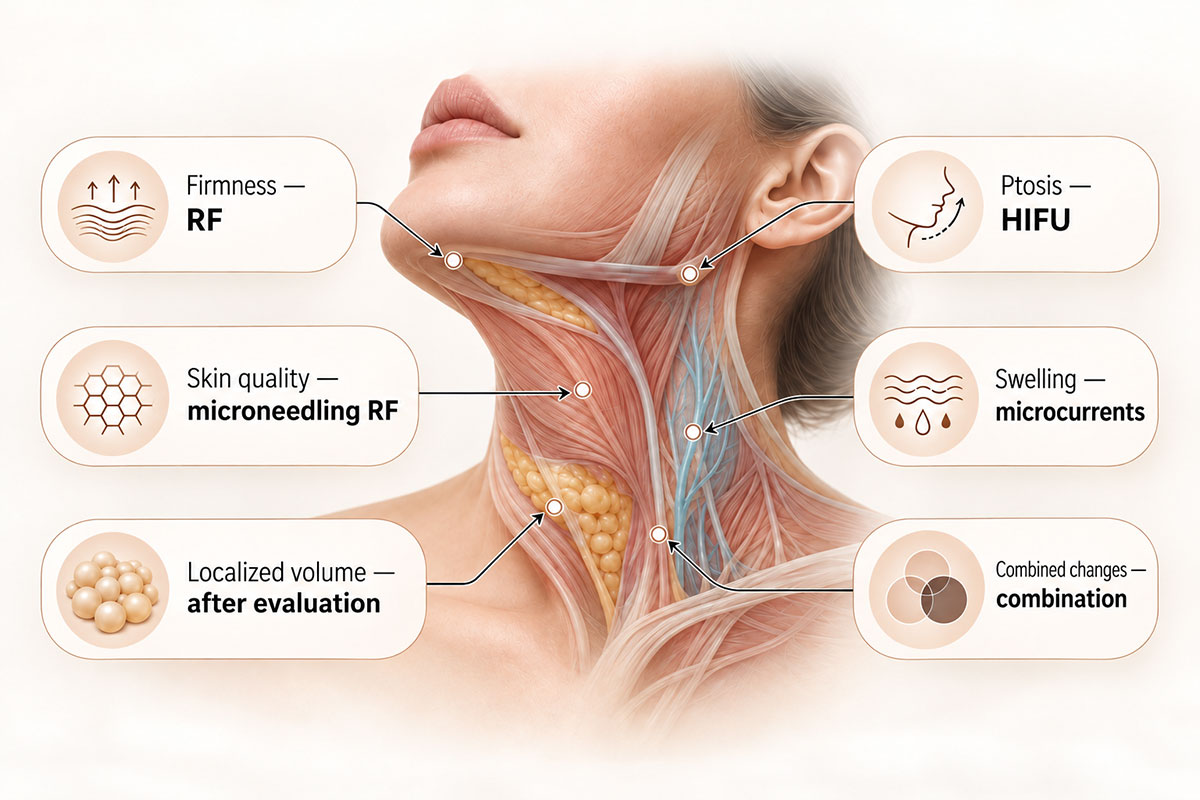
|
Primary concern |
Main treatment objective |
Technology to consider |
Key considerations |
|
Skin laxity |
improve skin firmness and contour |
RF |
system type and treatment parameters |
|
Ptosis of the lower third of the face |
deliver focused energy at a specific depth |
HIFU |
anatomy, tissue thickness, and treatment depth |
|
Skin laxity and changes in skin quality |
provide controlled treatment within the dermis |
microneedling RF |
treatment depth, cartridge type, and recovery |
|
Swelling or fluid retention |
support muscle tone and lymphatic drainage |
microcurrent therapy |
the complementary role of the treatment |
|
Pronounced localized fullness |
identify the tissues contributing to the volume |
select a method after an in-person assessment |
do not automatically consider fullness an indication for HIFU or RF |
|
Combination of concerns |
address multiple contributing factors |
a sequence of complementary treatments |
treatment compatibility and intervals specified in the protocols |
This table is not a ready-to-use treatment protocol. The appropriate choice depends on tissue condition, contraindications, the capabilities of the specific equipment, and a professional assessment of the client.
What aestheticians should assess before treatment
The assessment should include the nature of submental fullness, skin elasticity, the degree of ptosis and jowling, jawline definition, and the transition between the chin and neck. The submental region contains muscles, blood vessels, salivary glands, and branches of the facial nerve. Therefore, treatment must remain within the anatomical areas and depths authorized by the equipment manufacturer.
The next consideration is the treatment objective. For one client, the priority may be improving skin quality; for another, it may be achieving a more defined jawline or addressing tissue ptosis. The phrase "get rid of a double chin" is too broad for a professional treatment protocol. The selected technology must address the specific component responsible for the concern.
Unusual or sudden swelling, pronounced asymmetry, palpable lumps, tenderness, or changes of unknown origin require medical evaluation before any aesthetic procedure.

How to choose a device for a salon or clinic
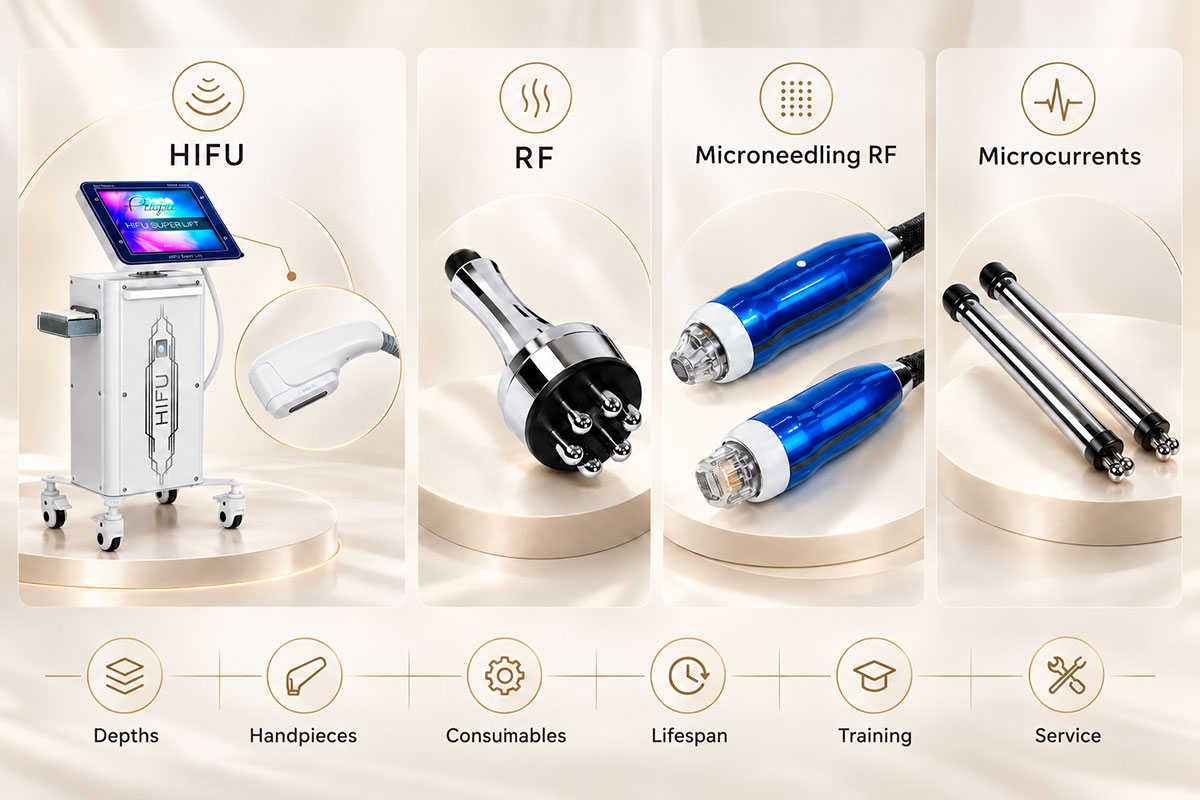
Equipment should be evaluated based on how well it meets the actual needs of a practice, rather than simply by the number of functions it offers. For protocols requiring focused energy delivery at specific depths, practitioners may consider SMAS lifting machines. If the primary concern involves skin laxity and quality, radio frequency machines may be appropriate. For fractional treatment within the dermis, practitioners can evaluate microneedling radio frequency machines.
When comparing models, important factors include available treatment depths, adjustable parameter ranges, applicator types, cartridge lifespan, consumable costs, staff training options, and the terms of professional aesthetic equipment maintenance and service.
For example, the HIFU Super-Lift by Alvi Prague comes with 1.5, 3, 4.5, 8, and 13 mm transducers. The stated lifespan of an ultrasound transducer is 10,000 lines or six months from the date of equipment purchase, whichever comes first. Microneedling RF treatments require disposable cartridges, so their cost must be included when calculating the cost per procedure.
The financial viability of an equipment purchase should be evaluated before investing. A basic calculation starts with treatment revenue minus consumables, practitioner compensation, and other variable costs. The resulting contribution margin can then be compared with the equipment purchase price and projected monthly treatment volume. Although this calculation does not predict an exact payback period, it allows different devices to be evaluated using consistent criteria.
For a more detailed comparison of these two skin tightening approaches, see our article on RF lifting vs. HIFU. It explains the differences in their mechanisms of action without repeating the full technical discussion here.
Treatment limitations and safety considerations
HIFU, RF, and microneedling RF have different contraindications and procedural requirements. Applying a single universal list of contraindications to all systems would be inappropriate. Treatment decisions should be guided by the specific device instructions, the client's medical history, skin condition, and anatomical treatment area.
Noninvasive or minimally invasive procedures are not equivalent to surgical correction in cases involving substantial excess tissue or severe ptosis. Establishing realistic treatment expectations is an essential part of appropriate client selection.

Frequently asked questions
Can you get rid of a double chin without surgery?
Device-based treatments may improve facial contour when the concern involves skin laxity, tissue ptosis, or a combination of moderately pronounced changes. However, noninvasive correction has limitations when substantial excess tissue is present.
Which is better for a double chin: RF or SMAS lifting?
RF and HIFU, which is used for SMAS lifting, operate through different physical mechanisms. RF is more commonly considered for collagen remodeling and improving skin quality, while HIFU may be selected when focused energy delivery at a specific tissue depth is required. The appropriate choice depends on tissue condition and the treatment objective.
Can exercises and massage help reduce a double chin?
Exercises may influence muscle activity, while massage may help address swelling or fluid retention. However, neither is an equivalent substitute for device-based treatment of structural skin laxity, tissue ptosis, or localized fat deposits.
Why do slim people have a double chin?
The contour of the lower third of the face is determined by more than body weight. Localized fat distribution, chin and jaw anatomy, skin elasticity, the platysma muscle, and the degree of tissue ptosis all play important roles.
For aesthetic professionals, the selection process should follow a logical sequence: first identify the cause of the contour change, then define the treatment objective, select the appropriate technology, and only afterward determine the parameters of the specific device.