
RF microneedling or traditional microneedling for post-acne, enlarged pores, and skin texture
CONTENTS:
- How post-acne, enlarged pores, and uneven skin texture differ
- How traditional microneedling works and when to consider it
- How RF microneedling works and when it is chosen
- RF microneedling vs. traditional microneedling
- What to choose for post-acne, pores, and uneven texture: a practical algorithm
- What limitations, risks, and realistic expectations should be discussed before the procedure
- How to choose between traditional microneedling and RF microneedling
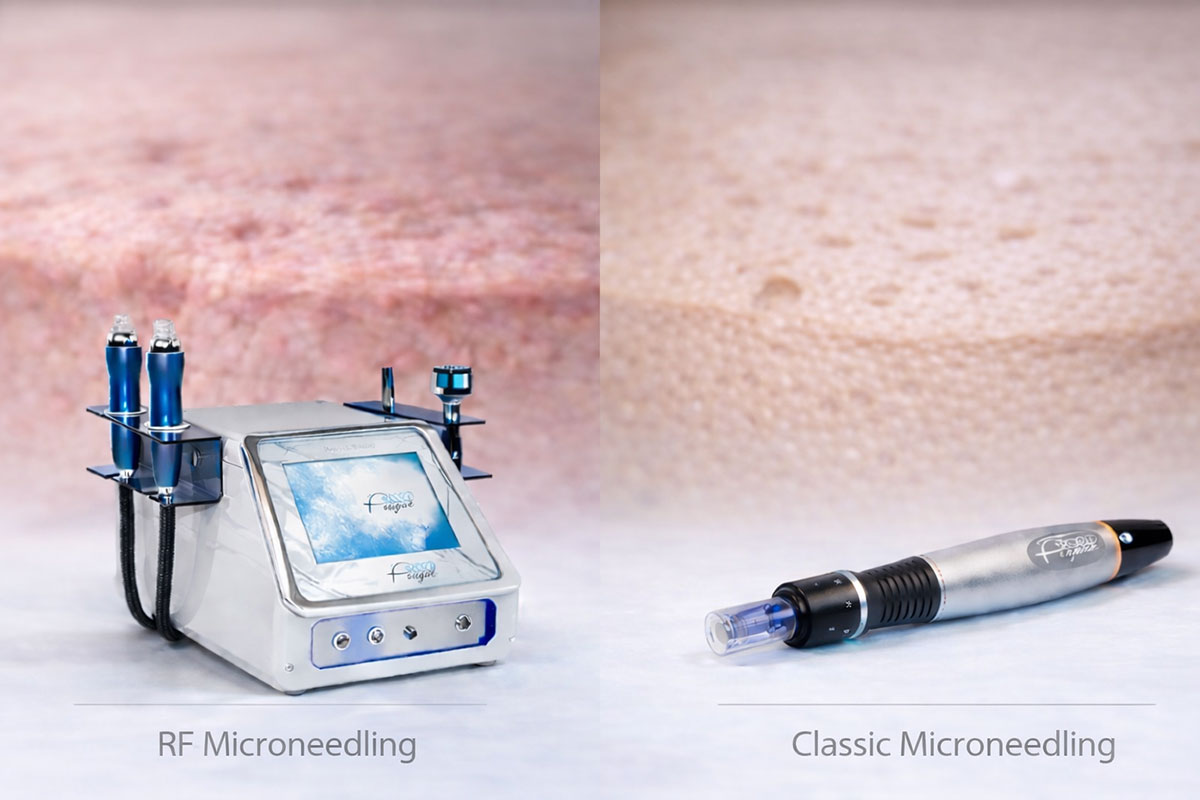
Post-acne, enlarged pores, and uneven skin texture are often grouped into one complaint, although these changes are driven by different processes. In some cases, the issue is a superficial irregular skin surface; in others, it is atrophic scarring, where the dermal structure itself has already changed. That is why traditional microneedling and RF microneedling should not be viewed as two identical procedures with different pricing or intensity. They are different tools with different depths of action.
Traditional microneedling creates controlled micro-injuries and triggers tissue repair. RF microneedling combines micro-injuries with radiofrequency heating in the dermis. This difference changes both the pattern of remodeling and the range of indications for which each technique is selected.
How post-acne, enlarged pores, and uneven skin texture differ
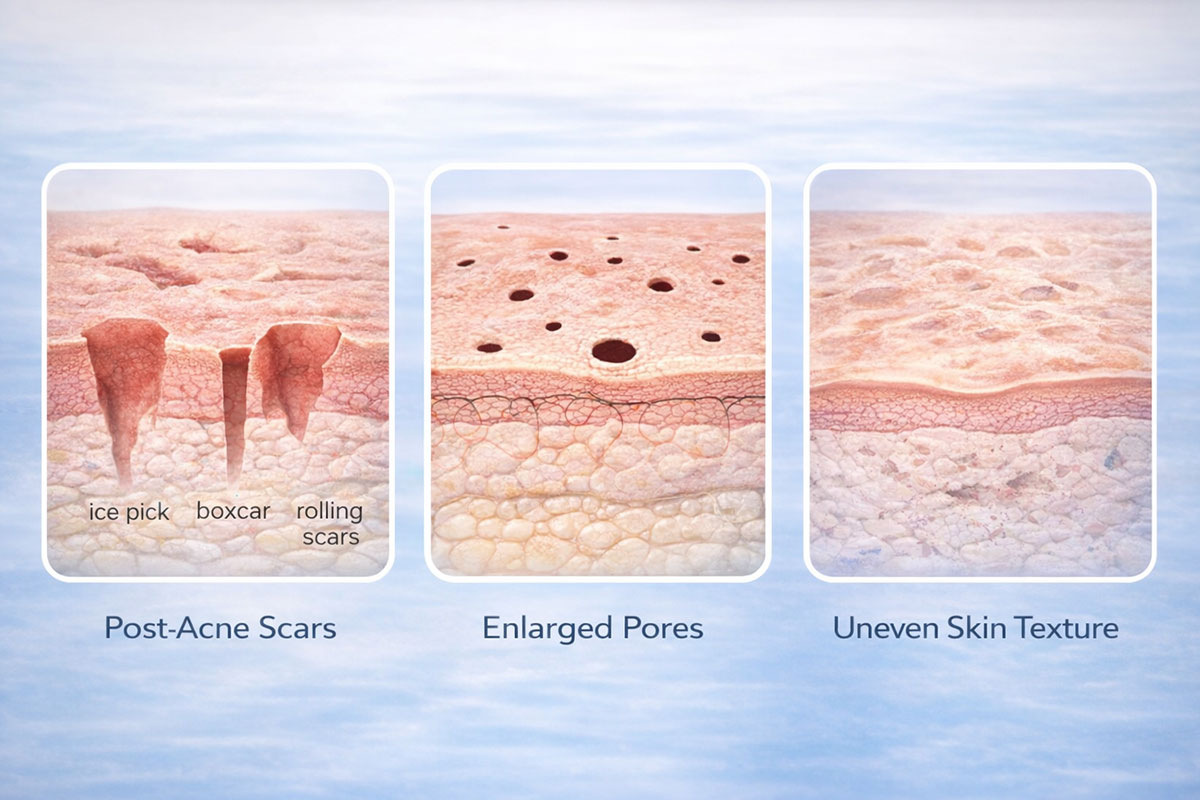
Post-acne is not the same problem for every patient. After acne, there may be discoloration, uneven skin surface changes, texture irregularities, and atrophic scars. In clinical practice, these scars are usually classified as ice pick, boxcar, and rolling scars. This classification matters not only for describing the skin in the patient chart. It also affects treatment planning, because scar shape, depth, and the presence of fibrous tethering determine how superficial or how deep the treatment should be.
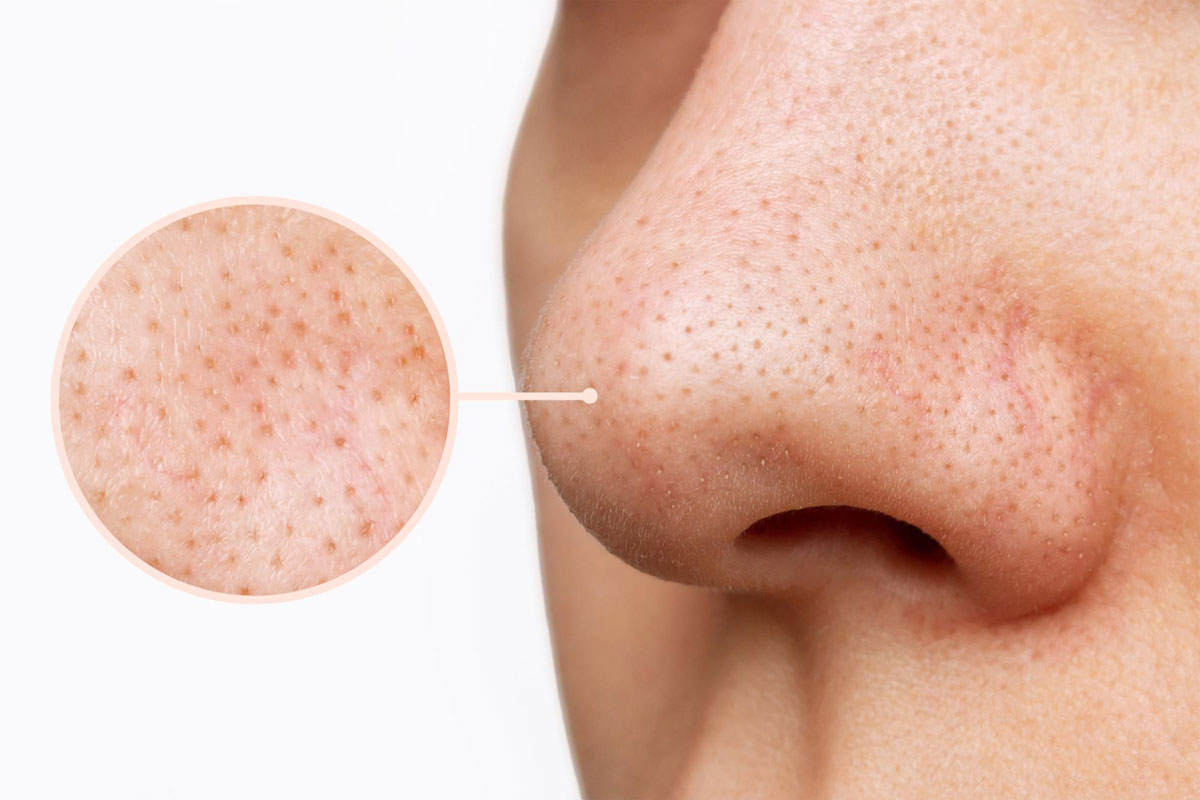
Enlarged pores have a different origin. Their appearance is related to the condition of the pilosebaceous unit, the level of sebum production, age-related changes in skin density, and the skin’s ability to maintain its structure. A person may describe this as “uneven” or “loose” skin, although scarring is not always the underlying issue.
Uneven skin texture is an even broader concept. It may include small depressions, roughness, an irregular microrelief pattern, residual post-inflammatory changes, and reduced smoothness. The same post-acne complaint may reflect different conditions and, accordingly, require a different corrective approach.
How traditional microneedling works and when to consider it
Traditional microneedling is based on multiple controlled micro-injuries. The skin responds with a repair cascade that includes dermal matrix remodeling and stimulation of neocollagenesis. As a result, the procedure is used to improve superficial and some moderately pronounced post-acne changes, refine skin microtexture, and reduce the visibility of pores.
The key feature of this technique is the absence of additional thermal injury. This makes it a clear option in cases involving shallow atrophic scars, dull skin, mild textural irregularity, and moderately visible pores. This approach is more commonly chosen when there is no need to work at substantial depth from the outset.
Recent 2025 reviews continue to support traditional microneedling as a practical method for atrophic post-acne scars, but the outcome depends on scar type, defect depth, and whether the procedure is combined with other modalities. For some patients, this level of treatment is sufficient. For others, it is not, especially when scars are deeper or the skin requires more pronounced remodeling.
How RF microneedling works and when it is chosen
RF microneedling combines mechanical and thermal action. The needles enter the tissue at a preset depth, after which radiofrequency energy is delivered. As a result, the skin receives not only controlled micro-injuries but also localized dermal heating. This changes the tissue response and enhances remodeling.
This approach is more often used for more pronounced atrophic scars, especially when scarring is combined with enlarged pores, uneven skin surface, and reduced skin density. RF microneedling is often included in treatment protocols for boxcar and rolling scars, since superficial stimulation alone may be insufficient in these cases.
One of the strengths of RF technology is that it allows deeper treatment without full ablative injury to the skin surface. At the same time, proper parameter selection, phototype assessment, and prediction of post-inflammatory hyperpigmentation risk become more important. That is why RF microneedling should not be perceived as an automatically better option. Its advantage becomes evident where deeper intervention is truly needed.
RF microneedling vs. traditional microneedling
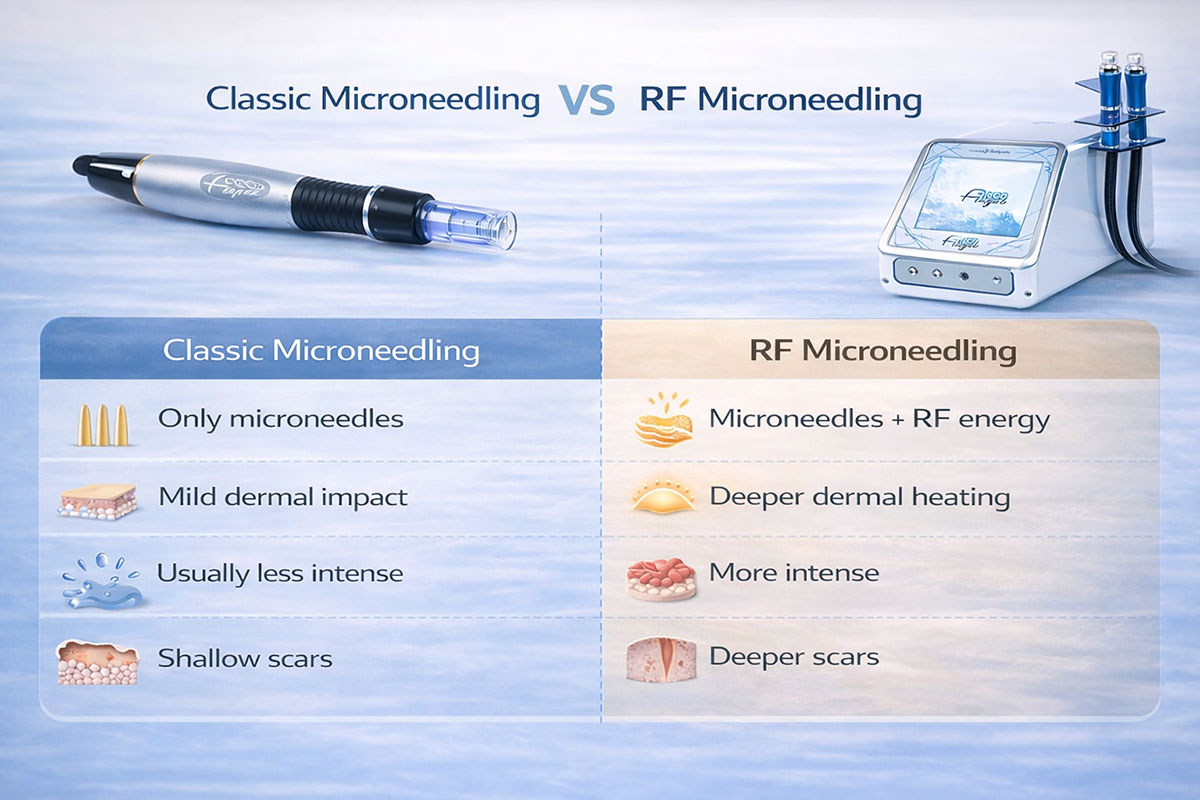
Both procedures are aimed at skin remodeling, but they should not be considered interchangeable. Traditional microneedling works through mechanical stimulation. RF microneedling adds a thermal component. This changes both the depth of treatment and the profile of indications.
|
Criterion |
Traditional microneedling |
RF microneedling |
|
Mechanism of action |
Mechanical micro-injuries |
Micro-injuries + radiofrequency heating of the dermis |
|
Main goal |
Collagen stimulation, texture refinement, improvement of pores and milder scars |
Deeper remodeling of scars and skin texture |
|
Most commonly used for |
Superficial and moderate post-acne changes |
More pronounced atrophic scars |
|
Work on pores |
Suitable for moderately visible pores |
More often chosen when enlarged pores are combined with reduced skin density |
|
Intensity of treatment |
Milder |
Higher |
|
Recovery |
Easier |
The reaction may be more noticeable |
|
Sensation during the procedure |
Moderate discomfort |
Often more intense |
|
Main risks |
Erythema, sensitivity, irritation |
Erythema, swelling, PIH, temporary pain |
|
Most commonly suitable for |
Patients with less deep defects |
Patients who need deeper remodeling |
Traditional microneedling is more often considered a starting tool for working with texture, pores, and less deep post-acne changes. RF microneedling is more often selected in cases where the scar component is more pronounced. The final decision is based not on the procedure name, but on scar type, phototype, inflammatory activity, and treatment tolerability.
What to choose for post-acne, pores, and uneven texture: a practical algorithm
In practice, the choice between these approaches usually depends not on the procedure name, but on which changes predominate in the skin and how deep a correction they require.
- If superficial surface irregularities predominate, along with moderately enlarged pores, dullness, and shallow post-acne changes, it is often more appropriate to start with traditional microneedling. In such cases, the skin needs gradual texture refinement and gentle remodeling without pronounced thermal impact.
- RF microneedling is more often chosen in more complex clinical situations. This includes more pronounced atrophic scars, a combination of scars with enlarged pores and uneven texture, as well as skin that requires stronger dermal remodeling. Here, radiofrequency energy provides the level of treatment that traditional technique may not deliver sufficiently.
- There are also cases where the question is not about choosing between two separate procedures at all. If scars have a fibrotic component, there is tethering, or the skin requires correction at several levels, the conversation shifts to a protocol-based approach. In such a regimen, microneedling or RF microneedling may be combined with subcision, laser modalities, chemical peels, PRP, and other tools.
What limitations, risks, and realistic expectations should be discussed before the procedure
Before selecting a procedure, specialists assess not only the indications but also the background against which the treatment will be performed. One of the key factors is active acne. When inflammatory lesions are still present, the inflammation itself should be brought under control first. Treating scars against this background increases the risk of trauma and a less predictable response.
Another important point is the course-based nature of treatment. Noticeable scar smoothing rarely develops after just one session. Dermal remodeling takes time, so results accumulate gradually.
Expected reactions after the procedure include temporary erythema, swelling, and skin sensitivity. After RF microneedling, these effects may be more pronounced. In patients with higher phototypes, the risk of PIH is assessed separately. At the same time, neither procedure completely erases scars. The realistic goal is different: to reduce the depth of defects, soften the skin surface, and make post-acne changes less visible.

How to choose between traditional microneedling and RF microneedling
Traditional microneedling and RF microneedling address similar, but not identical, concerns. For moderate texture irregularities, superficial post-acne changes, and enlarged pores, traditional microneedling is often sufficient. For more pronounced atrophic post-acne scars, RF microneedling more often provides a basis for expecting deeper remodeling.
The choice between these techniques is determined not by trends or by the device name. What matters is the scar type, depth of change, phototype, acne activity, and the skin’s readiness for a more intensive procedure. This approach is closer to real clinical practice and provides a more accurate understanding of the expected outcome.